Bend Oregon Acreage Homes: A Smart Buyer’s Guide
June 18, 2026
June 18, 2026
If you are shopping for acreage or an equestrian property around Bend, it helps to think beyond the house. A beautiful barn, open pasture, or a few extra acres can look perfect at first glance, but the real story is often in the zoning, water, access, and permit history. When you know what to verify early, you can move forward with more confidence and avoid expensive surprises later. Let’s dive in.
Buying rural property in Deschutes County is often as much a land decision as it is a home purchase. County property research tools are designed to help you verify acreage, zoning, permit history, tax assessment, transportation, floodplain status, service-provider coverage, and other historical details before closing.
That matters because two properties with similar acreage can offer very different real-world use. One parcel may be well set up for horses and outbuildings, while another may have limits that only become clear once you review county records.
Zoning is one of the first filters to use when you are looking at acreage around Bend. Deschutes County lists common rural base zones such as EFU, F1, F2, MUA10, RC, RI, RR10, and UAR10, and each one can affect what you may be able to do with the land.
For example, the county notes that RR-10 parcels may allow single-family dwellings, ADUs, agriculture, small-scale horse stables, and limited home businesses. If you want horses, a barn, a shop, or extra living space, zoning should be reviewed early, not after you are already emotionally invested in a property.
The county recommends using DIAL and the Summary Property Report before a purchase. These tools can show zoning, subdivision status, acreage, permit history, and tax lot details in one place. For acreage buyers, the legal setup of the parcel can matter more than how the property is described in marketing remarks.
Around Bend and greater Central Oregon, water can be one of the most important parts of an acreage purchase. Under Oregon law, water belongs to the public, and a landowner does not automatically have the right to use water that flows past, through, or under the property.
That means a creek, canal, ditch, or green pasture does not automatically confirm usable irrigation rights. In practical terms, buyers should verify whether the property has district irrigation or another legal water source, whether that arrangement is tied to the parcel, and when water is actually delivered.
Deschutes County identifies several irrigation districts serving the area, including Arnold, Central Oregon, North Unit, Swalley, Three Sisters, and Tumalo. County planning documents also note how important district irrigation is for active agricultural use in Central Oregon.
Tumalo planning materials offer a good local example. They note that Tumalo Irrigation District serves about 7,400 irrigated acres, while Swalley Irrigation District serves about 4,333 irrigated acres east of the Deschutes River. If you want pasture for horses, hay production, or other land-based use, irrigation delivery and seasonality may matter more than the raw acreage number.
If the property uses a domestic well, water due diligence has two parts: quantity and quality. Oregon Water Resources Department well reports can show details such as well depth, casing size, flow rate, and water level.
The state also says a well ID label must be applied within 30 days of property transfer if one is missing. In addition, Oregon Health Authority guidance says that when a home or property with a domestic well is sold, the seller or representative has 90 days to send test results to the buyer and to the state.
Those required tests focus on arsenic, nitrate, and total coliform bacteria. For buyers, this is a helpful reminder that a producing well and a tested well are not the same thing.
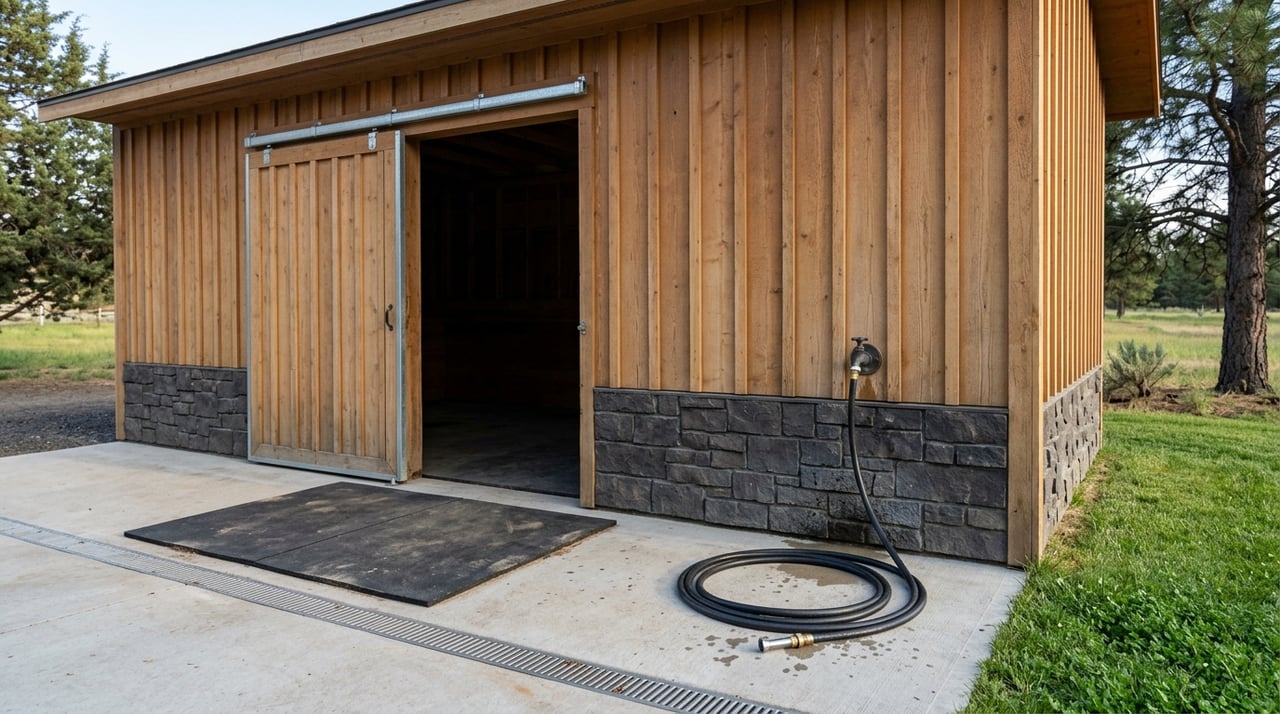
A horse property is often defined by its improvements as much as by the house itself. Barns, tack rooms, stalls, wash racks, arenas, shops, and guest spaces can add tremendous value, but they should be checked carefully against county records.
Deschutes County notes that new homes, accessory structures, and changes of use can trigger building and septic review. The county’s onsite wastewater guidance also makes clear that a septic permit is required when someone constructs, installs, alters, or repairs an onsite system.
This is especially important when an outbuilding has utilities or any kind of living space. What looks like a simple barn on a showing may involve plumbing, electrical, mechanical, or wastewater rules.
Deschutes County does offer an agricultural or equine exempt permit path, but it is limited. The county states that only buildings in EFU, F1, F2, or MUA10 zones that are receiving farmland or forestland tax deferral will be considered for exemption.
If plumbing is proposed, additional permits and a septic permit may still be required. In other words, acreage alone does not make a structure exempt, and the presence of horses does not automatically settle the issue either.
If a property includes a guesthouse, caretaker unit, or another secondary living space, those uses can have their own permit path. Before closing, it is wise to verify whether each major structure was permitted, exempt, or later converted to a different use.
Rural access is easy to overlook when the setting is beautiful, but it can affect daily life in a big way. Deschutes County’s Road Department maintains about 900 miles of county roads, but the county also says there are more than 600 additional miles of rural roads dedicated to public use that are not maintained by any government jurisdiction.
In those situations, maintenance can fall to adjacent property owners. That can affect road grading, snow removal, shared costs, and how easy it is to reach the property in all seasons.
The county also notes that special road districts are an option in some areas. For acreage buyers, this means you should understand not just how a road looks on showing day, but who maintains it and how that responsibility is handled over time.
Around Bend, wildfire exposure is an important part of buying rural property. The Oregon State Fire Marshal finalized a defensible-space model code in May 2026, and Oregon wildfire prevention guidance continues to emphasize creating a 30-foot perimeter of defensible space around the home.
Deschutes County has also published wildfire mitigation proposals for rural properties, which shows that fire-hardening remains an active local planning issue. For buyers, that means it is smart to evaluate both the current condition of the property and the likely maintenance needed after closing.
Floodplain review can also matter, especially on river-adjacent or lower-lying acreage near places like Tumalo and the Deschutes River corridor. Deschutes County’s DIAL tool can flag whether a parcel is in the FEMA 100-year floodplain, and local planning documents note floodplain zoning along river-corridor properties in the Tumalo area.
When you are comparing acreage and equestrian properties around Bend, these are some of the most important questions to answer before you remove contingencies:
Compared with an in-town home, acreage and equestrian properties usually require more verification before closing and more hands-on management after closing. Much of the value may sit in the land itself, but that value depends on water rights, irrigation delivery, septic capacity, road access, legal use of outbuildings, and exposure to wildfire or floodplain constraints.
The tradeoff is straightforward. These properties can offer privacy, flexibility, room for animals, and a true Central Oregon lifestyle, but they also bring more complexity and more owner responsibility.
The key is to verify how the property actually performs, not just how it photographs. If you want a calm, informed buying process for acreage or equestrian property around Bend, Erica Callfas can help you evaluate the details that matter most.
Stay up to date on the latest real estate trends.


Contact Erica today to learn more about her unique approach to real estate and how she can help you get the results you deserve.